Open to Equilibrium- Mancinelli’s Poetry
A Review of Franca Mancinelli’s ‘At an Hour’s Sleep from Here’ (Poems 2007-2019) Translated from Italian by John Taylor
The Bitter Oleander Press
ISBN #978-0-9993279-6-8
Reviewed by Gopal Lahiri
Open to Equilibrium- Mancinelli’s Poetry
Poetry is a way to bridge, to make bridges from one continent to another, one country to another, one person to another, one time to another. Franca Mancinelli (b. 1981) is regarded as one of the most important contemporary Italian poets and there is a strikingly matured voice in her writing. Her first two collections of poems, Mala kruna (2007) and Pasta madre (2013), along with a selection of new poems are translated by John Taylor, an American writer and critic, in the book titled ‘ At an Hour Sleep from Here’. Her poems in this book echo our current moment and these poems are amazing rasps of empathy, reaching far into our lives. There’s something delightful about this bilingual edition, each poem translated in English paired with its original Italian on the facing page.
Mark Glanville, wrote in Times Literary Supplement, “Mancinelli explores the fault lines (faglie) across which religions attempt to build bridges that philosophers would remove, using the third way, of poetry’. In a collection notable for its tonal and broad variety, most of the poem stand out in their nuanced expression and luminous words.
One of poetry’s most alluring elements can be its blend of observations. How do these things gel together? someone might ask. Mancinelli’s poems often contain a perceptible moment or two, then something startling or surprising drops in. These poems of layering counterpoint feel a lot like the world. The larger reckoning is what ultimately gives its power and resonance. After all, what is love? The book’s elegant language immerses the reader with immediate effect and it shines its blazing light on her poems and feels truly magical.
Mancinelli has an eye for the vivid image, allowing her to bring distant landscapes into sharp focus. “Going away already means freeing oneself,” she explains in an interview, “while I always return to my prisons. The epigraph rightly comprises the abandonment of emotional ties that can announce a departure, or the acknowledgment of a tragedy.” Here is a poet who has made us read for craft, skill and think about why things worked in a seamless manner. Plays on words and tiny twists mean much in the following poem.
You resist amid the silence of clocks
that beckon you to fish on the shore:
a moment of expanding quiet
has pushed you headfirst into the mirror,
opening your mouth. (The House of Ruins in Mala Kurna)
‘Ever drawing on concrete experience—be it hers or humanity’s— Mancinelli’s poetry thereby opens onto cosmic and spiritual perspectives encompassing the archaic and the contemporary, the origin that is within the present moment.’ John Taylor wrote in his preamble. Her poems at times quite complex or majestic in their utter simplicity. In the following poem, the voyages inwards are the ultimate objectives and the voice entraps in its own words losing grip over the long journey.
Then the needle in your flesh
you don’t know when it will jab again
surgical cotton this endless moment
has become, you don’t know. . . (Beyond the Merry Go Round in Mala Kurna)
The poet is someone seeking … a sort of non-existence, the quest for which can lead, paradoxically, to the discovery of the self, set free from the perplexity of context. And in the deceptively economic poem called “Locked In,” she reminds us just how perilous it sometimes is to be a woman in the world, no matter how seemingly placid the setting. The poem is born of such realisation.
suddenly the constructions were collapsing,
the wave was entering the green swimsuit.
When I stood up, I knew
what happens to a woman
after the sun has sunk into the spirals
now become solidified salt
and other dead shells. (The Sea in My Temples in Mala Kurna)
“In Franca Mancinelli’s writing nothing is ornamental, and everything comes from a deep wound.’ remarked Fabio Pusterla. The poet is at her best here – note the seeming effortlessness of the inscription, the casual utterances “Friends darkening with the seasons”. There’s a marvelously sharp accuracy at times but it isn’t allowed to undermine the mood and atmosphere, the metaphorical ending of the poem.
‘from this barricaded apartment
you watch friends darkening with the seasons
genealogies from the sweater’s threads.
Footprints of extinct animals’ beckon to you,
the galaxies are blooming on the balcony.’ (The House of Ruins in Mala kurna)’.
Her words open up on a broad canvas, unpacking everyday lives with startling originality. For the readers, there is no certainty about what is imagined and what is real and the poet gives updates of her writing landscape, sometimes far reaching detours.
how the world lulls and things
once again tremble,
I too will be in darkness. (Beyond the Merry Go Round in Mala Kurna)
Each poem feels like a maze designed to take the poet and the reader to some destination even though the admission of the poet ‘how much sand fallen on my eyes,’ and yet ‘years that lose words from my open fingers ‘the poetic canvas expands in silence. She applies shocks to the language, twists not at the end but at several levels, weave words, and the poem becomes a force to be reckoned with. She writes with an enlightening fluency – especially about human relations and ‘combines an extraordinary stylistic lucidity with a visionary gaze that dialectically questions reality, without transfiguring or overturning it’ as observed by the poet and critic Carmen Gallo.
‘I’ve written what I wanted to tell you
under my eyelids.
Tomorrow once I open them, you will read.
But just look at me and I won’t have
to carry all this whiteness between my lashes.
Give me your eyes and I will be saved.’ (Mother Dough)
Reading her you get a sense of belonging beneath the surface. Her work has always retained the intimacy and directness. Her carefully weighted words tips into fraught, interesting terrain carving out a new identity. She occasionally writes lyrical poems with surreal twist.
‘I’ll stitch up with simple kisses,
pour saliva into every joint,
be peeled and sweet to teeth.
Every morning I’ll pick you a fistful
of flowers from the cobblestones.
For you I’ll have evergreen needles
and bloom every winter to burn myself up. (Mother Dough)
You come to this book for compassion and feeling. The rhythm is mesmerising, too, and the poet paces her lines like a sleeper ride, quickening to elation, slowing to despair, and always keeping us with her and at the end manages to create an array of voices and an entirely recognisable objective.
‘you were made by the whites of the eyes.
From bits of rubble
year by year I gathered you up.
Now I close the arteries,
come back maimed to life. (On the Train of my Blood in Mala Kurna)
Delving into the flesh and soul, the poet wants to learn why the idea of ‘less is more’ keeps surfacing. If there is a failing, it is not sinking into the tedium of physicality but turn out to be concurrently a strong point. Her poems often interrogate and pull snippets of life out of the air, capturing the pain and wounds in a seamless manner.
‘into this gangrene opened by gestures
I see, and stop sprouting
this useless resin.
Then with my lips I pick myself up,
carry myself to bed as would
a cat her kitten.’. (Mother Dough).
The poet weaves words that feel like whispers and the disparate images drift strangely in poems that wonder while the digital anxieties are embedded throughout the collection, the relationship becomes a crucible, driven by its shared grief.
with footsteps that would like to plant
stones and seeds in cadence
I’m going to give back to the leaves
the tree they have lost,
to the fallen feathers the bird.
Then I cross my arms
and my heart returns to its cage. (Out of Focus, Out of the Fire)
There is no denying that she is among the most acclaimed poets on the Italian poetry scene. Her voice has a sharp, rhythmic perfection and it gives a very powerful and efficient drive to her poems. It all sounds like real mastery, like brilliance attained in weaving words.
In “At an Hour’s Sleep,” the poet makes us wonder at every corner and her unrivaled powers of observation, alluring assignation with daily life and her grand oeuvre should be met with a round of applause.
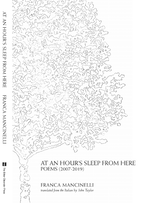
The cover page is splendid. The book is appealingly written and beautifully balanced. It’s a must for every book shelf.
About the Reviewer:
Gopal Lahiri is a Kolkata- based bilingual poet, critic, editor, writer and translator with 20 books published including three joint books. His work has been published worldwide!
Poetry is a way to bridge, to make bridges from one continent to another, one country to another, one person to another, one time to another. Franca Mancinelli (b. 1981) is regarded as one of the most important contemporary Italian poets and there is a strikingly matured voice in her writing. Her first two collections of poems, Mala kruna (2007) and Pasta madre (2013), along with a selection of new poems are translated by John Taylor, an American writer and critic, in the book titled ‘ At an Hour Sleep from Here’. Her poems in this book echo our current moment and these poems are amazing rasps of empathy, reaching far into our lives. There’s something delightful about this bilingual edition, each poem translated in English paired with its original Italian on the facing page.
Mark Glanville, wrote in Times Literary Supplement, “Mancinelli explores the fault lines (faglie) across which religions attempt to build bridges that philosophers would remove, using the third way, of poetry’. In a collection notable for its tonal and broad variety, most of the poem stand out in their nuanced expression and luminous words.
One of poetry’s most alluring elements can be its blend of observations. How do these things gel together? someone might ask. Mancinelli’s poems often contain a perceptible moment or two, then something startling or surprising drops in. These poems of layering counterpoint feel a lot like the world. The larger reckoning is what ultimately gives its power and resonance. After all, what is love? The book’s elegant language immerses the reader with immediate effect and it shines its blazing light on her poems and feels truly magical.
Mancinelli has an eye for the vivid image, allowing her to bring distant landscapes into sharp focus. “Going away already means freeing oneself,” she explains in an interview, “while I always return to my prisons. The epigraph rightly comprises the abandonment of emotional ties that can announce a departure, or the acknowledgment of a tragedy.” Here is a poet who has made us read for craft, skill and think about why things worked in a seamless manner. Plays on words and tiny twists mean much in the following poem.
You resist amid the silence of clocks
that beckon you to fish on the shore:
a moment of expanding quiet
has pushed you headfirst into the mirror,
opening your mouth. (The House of Ruins in Mala Kurna)
‘Ever drawing on concrete experience—be it hers or humanity’s— Mancinelli’s poetry thereby opens onto cosmic and spiritual perspectives encompassing the archaic and the contemporary, the origin that is within the present moment.’ John Taylor wrote in his preamble. Her poems at times quite complex or majestic in their utter simplicity. In the following poem, the voyages inwards are the ultimate objectives and the voice entraps in its own words losing grip over the long journey.
Then the needle in your flesh
you don’t know when it will jab again
surgical cotton this endless moment
has become, you don’t know. . . (Beyond the Merry Go Round in Mala Kurna)
The poet is someone seeking … a sort of non-existence, the quest for which can lead, paradoxically, to the discovery of the self, set free from the perplexity of context. And in the deceptively economic poem called “Locked In,” she reminds us just how perilous it sometimes is to be a woman in the world, no matter how seemingly placid the setting. The poem is born of such realisation.
suddenly the constructions were collapsing,
the wave was entering the green swimsuit.
When I stood up, I knew
what happens to a woman
after the sun has sunk into the spirals
now become solidified salt
and other dead shells. (The Sea in My Temples in Mala Kurna)
“In Franca Mancinelli’s writing nothing is ornamental, and everything comes from a deep wound.’ remarked Fabio Pusterla. The poet is at her best here – note the seeming effortlessness of the inscription, the casual utterances “Friends darkening with the seasons”. There’s a marvelously sharp accuracy at times but it isn’t allowed to undermine the mood and atmosphere, the metaphorical ending of the poem.
‘from this barricaded apartment
you watch friends darkening with the seasons
genealogies from the sweater’s threads.
Footprints of extinct animals’ beckon to you,
the galaxies are blooming on the balcony.’ (The House of Ruins in Mala kurna)’.
Her words open up on a broad canvas, unpacking everyday lives with startling originality. For the readers, there is no certainty about what is imagined and what is real and the poet gives updates of her writing landscape, sometimes far reaching detours.
how the world lulls and things
once again tremble,
I too will be in darkness. (Beyond the Merry Go Round in Mala Kurna)
Each poem feels like a maze designed to take the poet and the reader to some destination even though the admission of the poet ‘how much sand fallen on my eyes,’ and yet ‘years that lose words from my open fingers ‘the poetic canvas expands in silence. She applies shocks to the language, twists not at the end but at several levels, weave words, and the poem becomes a force to be reckoned with. She writes with an enlightening fluency – especially about human relations and ‘combines an extraordinary stylistic lucidity with a visionary gaze that dialectically questions reality, without transfiguring or overturning it’ as observed by the poet and critic Carmen Gallo.
‘I’ve written what I wanted to tell you
under my eyelids.
Tomorrow once I open them, you will read.
But just look at me and I won’t have
to carry all this whiteness between my lashes.
Give me your eyes and I will be saved.’ (Mother Dough)
Reading her you get a sense of belonging beneath the surface. Her work has always retained the intimacy and directness. Her carefully weighted words tips into fraught, interesting terrain carving out a new identity. She occasionally writes lyrical poems with surreal twist.
‘I’ll stitch up with simple kisses,
pour saliva into every joint,
be peeled and sweet to teeth.
Every morning I’ll pick you a fistful
of flowers from the cobblestones.
For you I’ll have evergreen needles
and bloom every winter to burn myself up. (Mother Dough)
You come to this book for compassion and feeling. The rhythm is mesmerising, too, and the poet paces her lines like a sleeper ride, quickening to elation, slowing to despair, and always keeping us with her and at the end manages to create an array of voices and an entirely recognisable objective.
‘you were made by the whites of the eyes.
From bits of rubble
year by year I gathered you up.
Now I close the arteries,
come back maimed to life. (On the Train of my Blood in Mala Kurna)
Delving into the flesh and soul, the poet wants to learn why the idea of ‘less is more’ keeps surfacing. If there is a failing, it is not sinking into the tedium of physicality but turn out to be concurrently a strong point. Her poems often interrogate and pull snippets of life out of the air, capturing the pain and wounds in a seamless manner.
‘into this gangrene opened by gestures
I see, and stop sprouting
this useless resin.
Then with my lips I pick myself up,
carry myself to bed as would
a cat her kitten.’. (Mother Dough).
The poet weaves words that feel like whispers and the disparate images drift strangely in poems that wonder while the digital anxieties are embedded throughout the collection, the relationship becomes a crucible, driven by its shared grief.
with footsteps that would like to plant
stones and seeds in cadence
I’m going to give back to the leaves
the tree they have lost,
to the fallen feathers the bird.
Then I cross my arms
and my heart returns to its cage. (Out of Focus, Out of the Fire)
There is no denying that she is among the most acclaimed poets on the Italian poetry scene. Her voice has a sharp, rhythmic perfection and it gives a very powerful and efficient drive to her poems. It all sounds like real mastery, like brilliance attained in weaving words.
In “At an Hour’s Sleep,” the poet makes us wonder at every corner and her unrivaled powers of observation, alluring assignation with daily life and her grand oeuvre should be met with a round of applause.
The cover page is splendid. The book is appealingly written and beautifully balanced. It’s a must for every book shelf.
About the Reviewer:
Gopal Lahiri is a Kolkata- based bilingual poet, critic, editor, writer and translator with 20 books published including three joint books. His work has been published worldwide!